
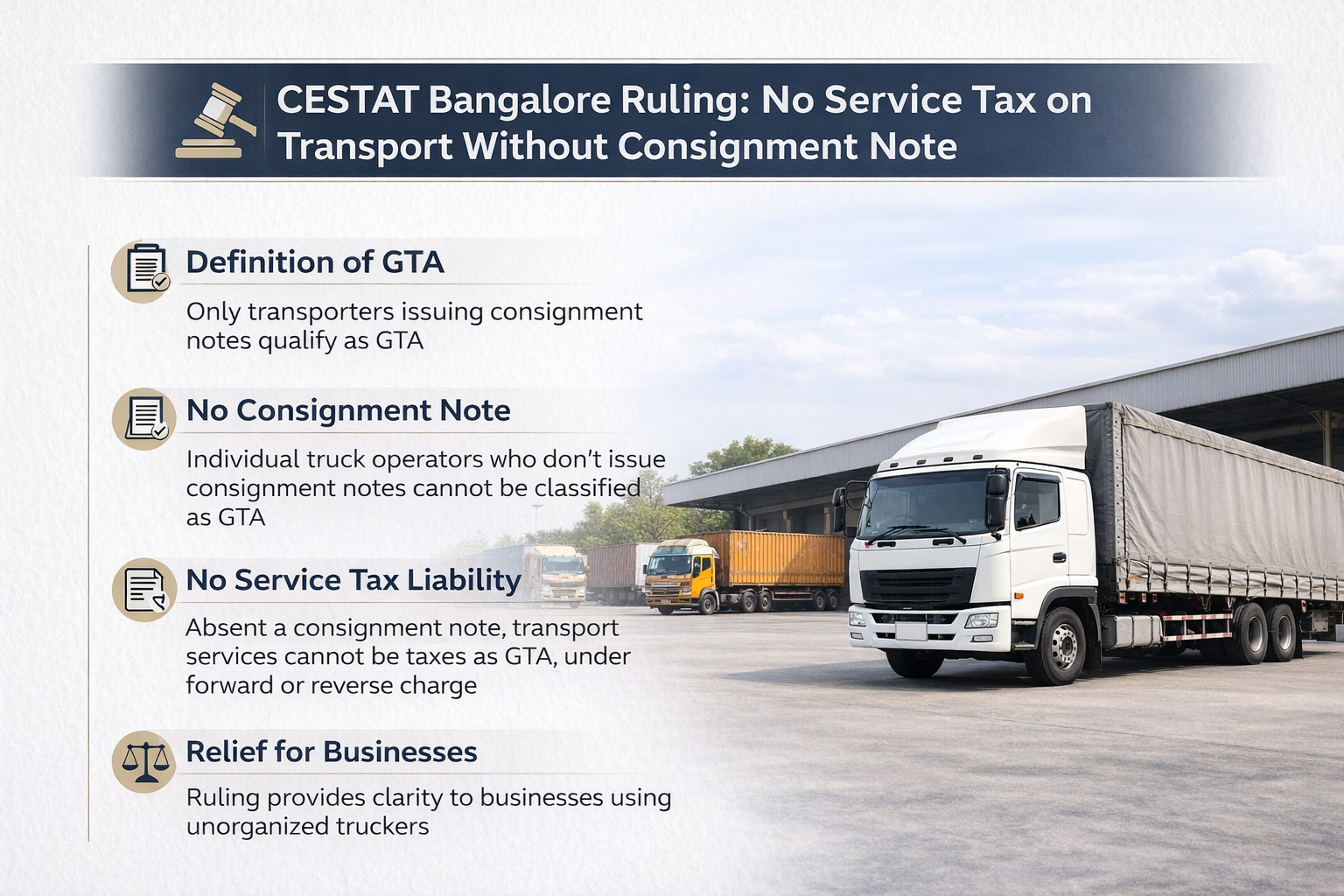
In a significant ruling, the CESTAT Bangalore has held that transport services provided by individual truck operators, without issuance of a consignment note, do not qualify as Goods Transport Agency (GTA) services and are therefore not liable to service tax. This judgment reiterates a long-standing principle under service tax jurisprudence—issuance of a consignment note is a sine qua non for classification as GTA service.
Background and Legal Context
Under the erstwhile service tax regime, transport of goods by road was taxable only when provided by a “Goods Transport Agency” as defined under Section 65B(26) of the Finance Act, 1994. A critical element of this definition was the issuance of a consignment note.
A consignment note signifies:
- Transfer of lien over goods to the transporter
- Acknowledgment of receipt of goods for transportation
- Responsibility for safe delivery
In the absence of such a document, transporters are treated as individual truck operators, who fall outside the ambit of GTA and consequently outside the service tax net. This distinction has historically created litigation, especially where businesses engage multiple small truck operators without formal documentation.
Industry Scenario: Persistent Classification Disputes
The logistics and transportation sector in India is highly fragmented, with a large portion comprising small, unorganized truck operators. Many of these operators:
- Do not issue consignment notes
- Operate on per-trip or per-load basis
- Lack formal documentation practices
Tax authorities have often attempted to classify such services as GTA to widen the tax base, particularly invoking reverse charge mechanisms on service recipients. This has led to repeated disputes on whether mere transportation of goods by road automatically qualifies as GTA service.
Facts of the Case
In the present case, the assessee had availed transport services from individual truck operators for movement of goods. Key characteristics of the arrangement included:
- No issuance of consignment notes by transporters
- Payments made directly to truck operators
- Absence of any centralized agency or organized transporter
The department sought to levy service tax under GTA services, contending that transportation of goods by road falls within the taxable category.
The assessee argued that:
- The essential condition of consignment note issuance was not fulfilled
- Therefore, the service cannot be classified as GTA
- Consequently, no service tax liability arises
Tribunal’s Observations and Ruling
The CESTAT Bangalore ruled in favor of the assessee, emphasizing the following:
- Consignment Note is Mandatory
The tribunal reaffirmed that issuance of a consignment note is an indispensable requirement for classification as a GTA service. - Nature of Individual Truck Operators
Individual truck owners/operators, who do not issue consignment notes, cannot be treated as GTA. - No Tax Liability in Absence of GTA Classification
Since the services did not qualify as GTA, the question of service tax liability—whether forward charge or reverse charge—does not arise. - Reliance on Established Jurisprudence
The ruling aligns with multiple precedents where courts and tribunals have consistently held that absence of consignment note excludes the service from GTA ambit.
Implications of the Ruling
This judgment has far-reaching implications for businesses, particularly in manufacturing, FMCG, infrastructure, and trading sectors that rely heavily on road transport.
1. Reinforcement of Legal Position
The ruling strengthens the settled legal principle that: “No consignment note = No GTA = No service tax.” This provides clarity and reduces interpretational ambiguity.
2. Relief from Reverse Charge Exposure
Businesses often face demands under reverse charge for GTA services. This ruling offers a strong defense where:
- Transporters are unorganized
- Documentation does not include consignment notes
3. Documentation Becomes Critical
While the ruling is favorable, it also highlights the importance of maintaining proper records to substantiate:
- Nature of transporter (individual vs agency)
- Absence of consignment notes
- Payment structure
4. GST Parallel
Though the case pertains to service tax, similar principles continue under GST:
- GTA is defined under Notification No. 12/2017-CT (Rate)
- Consignment note remains a defining criterion
Thus, the ruling holds persuasive value even in the GST regime.
What Businesses Need to Know
In light of this judgment, businesses should take the following steps:
A. Evaluate Transport Arrangements
- Identify whether transporters qualify as GTA
- Check if consignment notes are issued
B. Maintain Robust Documentation
- Preserve invoices, lorry receipts, and agreements
- Clearly demonstrate absence of consignment notes where applicable
C. Review Past Litigations
- Assess ongoing disputes involving GTA classification
- Consider leveraging this ruling as a defense
D. Align GST Practices
- Ensure correct classification under GST
- Avoid unnecessary tax payments under reverse charge where GTA definition is not met
Conclusion
The CESTAT Bangalore ruling brings much-needed clarity to the classification of transport services, particularly in cases involving unorganized truck operators. By reaffirming the centrality of consignment notes in defining GTA services, the tribunal has upheld a principle that balances legal interpretation with industry realities.
For businesses, the takeaway is clear: classification hinges not merely on the activity of transportation, but on the documentation that accompanies it. In an ecosystem where form often dictates taxability, the absence of a single document—the consignment note—can decisively alter tax outcomes.