
SC Seeks Centre’s Response on GST Relief for Disabled
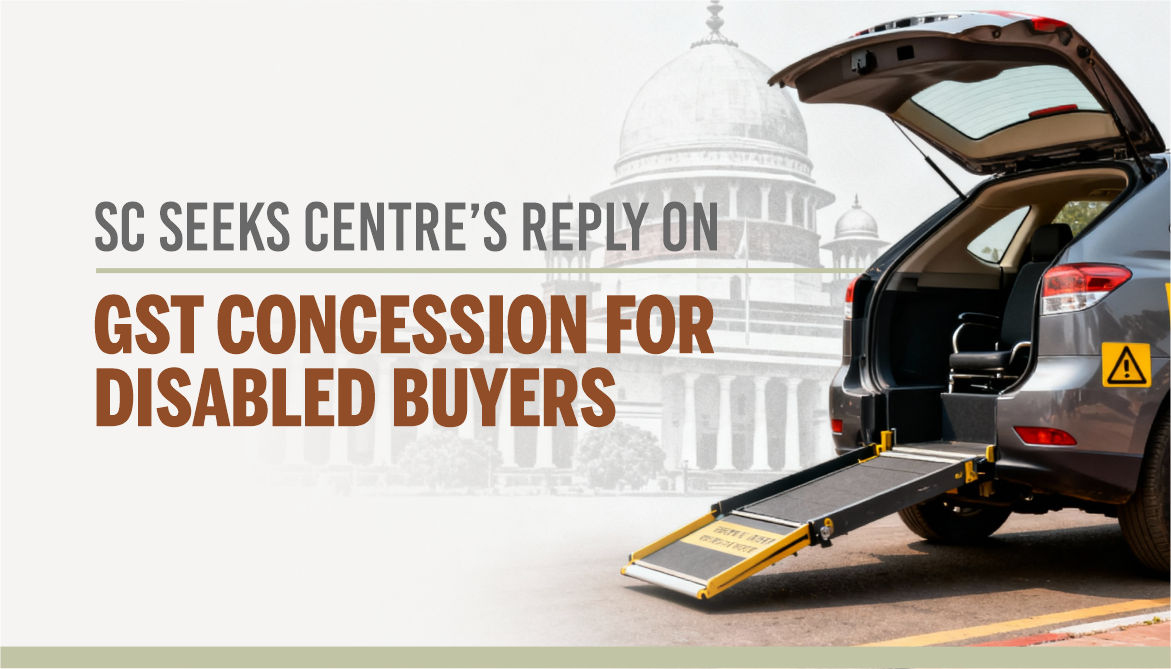
The Supreme Court has recently sought responses from the Union Government and the GST Council on a petition alleging that concessional GST benefits on the purchase of cars by persons with disabilities (PwD) have been effectively extinguished. The matter, heard by a bench of Justices Vikram Nath and Sandeep Mehta, has reignited a long-standing debate on how tax policy intersects with accessibility and mobility rights in India.
At the heart of the case is a plea filed by a 100% visually-impaired individual whose application for a GST concession certificate was rejected on the ground that the benefit was restricted only to persons with permanent orthopaedic disabilities. The Supreme Court has now issued notice, requiring the Centre to respond within four weeks. The issue is not merely administrative; it raises questions about statutory rights, policy consistency, and the GST regime’s approach to vulnerable groups.
Why This Case Matters
For many persons with disabilities, personal mobility is not a luxury but a necessity. Tax concessions on vehicles have long been recognised as a form of reasonable accommodation that bridges accessibility gaps. The petitioner argues that successive policy shifts since 2021 have diluted these benefits, leaving PwD across India subject to inconsistent treatment.
The plea further states that authorities not only reversed earlier positions supporting broader inclusivity but also discontinued the GST exemption certificate scheme altogether in late 2025. As a result, even persons with orthopaedic disabilities—previously covered—are now unable to access concessional rates.
This development raises a critical policy question: Should GST concessions tied to mobility be treated as a social welfare measure rather than a revenue consideration?
Historical Context: How Concessions Evolved Before and After GST
Pre-GST Regime (Excise Duty Concession)
The concessional tax treatment began in 1999, when the Ministry of Heavy Industries reduced excise duty on cars designed or modified for persons with disabilities. The scope was expanded in 2007, making the benefit more accessible. These measures recognised that modified vehicles often incur higher manufacturing costs. Concessional taxation helped neutralise this burden.
Post-GST Regime (2017 Onwards)
When GST subsumed excise duty in July 2017, the Ministry of Finance introduced a concessional GST rate of 18% on specially designed vehicles for persons with disabilities, compared to the higher standard rate applicable to other vehicles. The GST Council framed the exemption-certificate mechanism such that eligible PwD would first obtain certification and then purchase the vehicle at the concessional rate. This certificate acted as the control measure to prevent misuse.
However, according to the plea, the administration of this scheme became inconsistent from 2021 onward, with authorities taking contradictory positions in different High Courts.
The Technical Issue: How the Concession Is Being Extinguished
To understand the petitioner’s argument, one must examine the legal and procedural elements of the GST concession scheme.
1. Statutory Basis – Rights of Persons with Disabilities Act, 2016
Section 41 of the Act requires the government to make appropriate measures to ensure access to transportation for PwD. While the Act itself does not prescribe tax concessions, it sets the foundation for policy measures supporting mobility.
2. GST Framework – Rate Notifications and Certificate Mechanism
GST concessions were operationalised through Notifications under Section 9 of the CGST Act and corresponding SGST and IGST provisions. The concessional rate applied only where a PwD obtained a GST exemption certificate.
The petitioner argues that rejecting applications from non-orthopaedic disabilities is inconsistent with the broader statutory definition of “benchmark disability” under the 2016 Act.
3. Administrative Reversals
The plea outlines a troubling sequence:
-
2024: Ministry of Social Justice and Empowerment (MSJE) recommends extending the concession to all categories of benchmark disabilities.
-
Two weeks later: MSJE reverses its stand and restricts support only to orthopaedic disabilities.
-
2025: Authorities issue notices discontinuing the certificate scheme entirely, effectively ending concessional GST.
Such reversals have created what the petitioner calls “policy uncertainty” and “unequal treatment”, where PwD in similar circumstances face different outcomes depending on the interpretation adopted by local authorities.
4. Constitutional Challenge
The plea invokes Article 32, arguing that:
-
The withdrawal of the scheme is arbitrary (violating Article 14).
-
The move undermines accessibility rights under the RPwD Act.
-
The State has failed to provide reasonable accommodation, a core principle globally recognised in disability rights frameworks.
Broader Policy Implications
Tax concessions for PwD vehicles are not merely fiscal tools; they influence quality of life, independence, and economic participation. Mobility enhances employability, education access, and integration. When policy becomes inconsistent or unpredictable, the impact on PwD is disproportionate. Unlike general consumers, PwD often require customised vehicles, which come at a higher cost. Removing or weakening concessions increases this burden.
GST Governance and the Need for Policy Clarity
Under the GST regime, the GST Council plays a key role in determining exemptions and rate concessions. Discontinuation of the certificate scheme without providing a successor mechanism indicates a gap in policy planning.
While revenue neutrality and misuse avoidance are legitimate concerns, disability concessions operate within a social-welfare paradigm, not a commercial incentive structure. This distinction has not always been clearly reflected in administrative decisions.
The Supreme Court’s intervention may prompt a reconsideration of policy frameworks governing such socially sensitive concessions.
Conclusion: Policy Must Prioritise Accessibility and Dignity
India’s tax policy in the disability space must align with the principles of dignity, inclusivity, and reasonable accommodation embedded in the RPwD Act, 2016. Concessions for mobility are not mere fiscal indulgences; they are enablers of fundamental rights.
The present litigation highlights a larger concern: policy drift should not compromise the lived realities of persons with disabilities. Swift, consistent, and compassionate action is essential to restore confidence and ensure equitable access. As GST continues to evolve, aligning tax policy with social objectives will strengthen its legitimacy and inclusive character.