
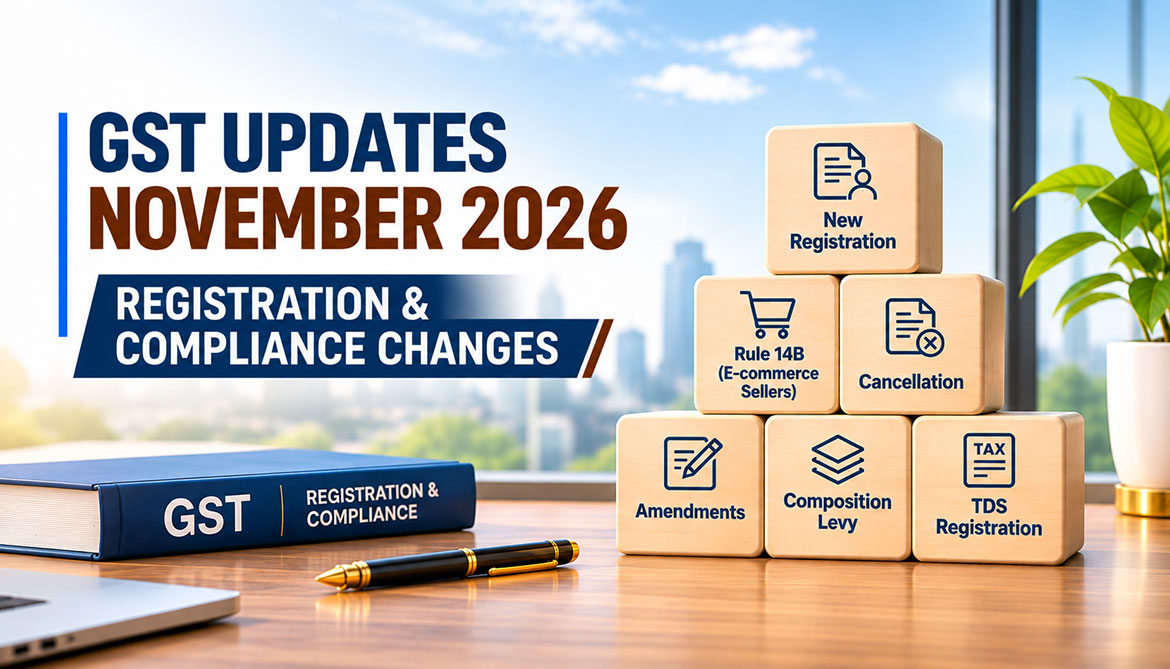
The GST updates issued on 1 November 2026 cover six areas of business compliance: new GST registration, simplified registration for eligible e-commerce sellers under Rule 14B, registration cancellation, amendments, composition levy and TDS registration for specified goods.
These GSTN advisories introduce revised information requirements and more automated portal processes. Businesses applying for registration, updating their particulars or closing a GST registration should check the relevant documents, eligibility conditions and verification deadlines. Accurate information and timely return filing remain essential to successful processing. This article explains all six compliance advisories, excluding the GST revenue collection report. GSTN advisories dated 1 November 2026.
GST Registration Changes in FORM GST REG-01
Who should pay attention: Businesses applying for a new GST registration through FORM GST REG-01.
The revised form introduces additional fields and clearer documentary requirements. Applicants should prepare the following before starting:
- Business constitution: One Person Company is now a separate category. Upload the relevant incorporation certificate, partnership deed or other prescribed evidence for the selected constitution.
- Special categories: SEZ units and developers must provide their SEZ Entity ID. E-commerce operators liable under Section 9(5) have a separate section covering physical presence and, where applicable, an authorised representative.
- Existing registrations: The revised disclosures expressly cover GSTIN, Professional Tax Registration Number and Professional Tax Enrolment Registration Number, along with other applicable particulars.
- Business premises: Select the correct category for owned, rented or leased, consent-based, co-working or SEZ premises, or premises in a deceased ancestor’s name, and provide the documents specified for that category.
- Business activities: The expanded list captures activities such as property rentals, vehicle/vessel/aircraft hiring, co-working spaces and health and fitness clubs, as well as factory registration and Authorised Economic Operator details where applicable.
- Bank accounts and identification numbers: Up to 10 bank accounts can be reported. Furnish available details with the application; if unavailable, provide them within 30 days of issuance of the registration certificate in REG-06. LLP applicants must furnish designated partners’ DINs. Applicable CIN, FCRN, LLPIN and FLLPIN details are subject to online validation.
An Application Reference Number, or ARN, will be generated only after the required information passes validation.
What to do: Update the registration checklist used by your accounts team or adviser. A mismatch between the selected premises category and its documents can hold up the process. GSTN advisory on FORM GST REG-01.
Rule 14B Simplified GST Registration for E-commerce Sellers
Who should pay attention: Suppliers of goods selling through e-commerce operators that collect tax at source under Section 52.
The new Rule 14B simplified registration facility allows eligible sellers to obtain registration in a State or Union Territory where they have no physical place of business, using an approved e-commerce operator’s warehouse as their principal or additional place of business.
For example, a seller with an eligible active registration in Gujarat may be able to use an approved operator’s warehouse address to register in another State, subject to the scheme’s conditions.
Rule 14B Eligibility and the Monthly Tax Liability Limit
The applicant must have neither physical presence nor an active regular registration in the destination State/UT. Only one registration under Rule 14B is permitted per PAN in that State/UT, in the regular taxpayer category. Composition taxpayers, ISDs, SEZ units/developers and casual taxpayers are excluded from this route, as are jurisdictions in the “Other Territory” category.
The seller must already have a regular, active registration under the same PAN in another State/UT, called the Home State GSTIN. That GSTIN cannot be under Rule 14A or Rule 9A or carry State Code 97; the advisory permits a Rule 14A taxpayer to withdraw from that scheme before applying under Rule 14B. No Section 29 proceedings should have been initiated, and no cancellation application should have been filed, for the home registration.
Two limits are particularly important:
- Total output tax liability on supplies to registered persons must not exceed ₹2.5 lakh per month, combining CGST, SGST/UTGST and IGST. This is a tax-liability limit, not a sales-turnover limit.
- The Rule 14B registration must be used exclusively for supplies through e-commerce operators.
E-commerce Operator Consent and Registration Timelines
Select the Rule 14B option in REG-01, enter the Home State GSTIN and request access to the operator’s warehouse addresses. The operator’s GSTIN must be regular, active and in the destination State, with an active TCS registration under the same PAN in that State/UT.
After address selection and system validations, the operator must provide the prescribed consent within seven working days. Without the required consent for the principal place of business, no ARN is generated.
Previously completed home-registration biometric Aadhaar authentication and document verification may be recognised. Where verification is required, it must be completed within the prescribed 15-day period from submission of Part B of REG-01 for ARN generation.
Where a field visit is required, the advisory provides for deemed approval on successful completion of the visit or expiry of 30 days from ARN generation, whichever is earlier. A negative home-registration field-visit report can cause pending Rule 14B applications across States/UTs to be automatically rejected.
What to do: Check eligibility and coordinate warehouse access, consent and verification with the operator before planning expansion around this facility. GSTN advisory on Rule 14B.
GST Registration Cancellation under REG-16
Who should pay attention: Taxpayers applying to cancel their registration through FORM GST REG-16.
The revised process allows electronic approval without officer intervention where the prescribed conditions are met.
First, all applicable returns due on or before the requested effective cancellation date must be filed before the cancellation application can be submitted. If GSTR-1 or the Invoice Furnishing Facility has been used for a tax period, the corresponding GSTR-3B must also be filed.
Where returns relating to the period up to cancellation are still to become due, the application may move to “Pending for Returns Filing”. File those returns within their respective due dates; failure sends the application to the jurisdictional officer.
Once the required returns are filed on time, the approval route depends on the taxpayer category:
| Taxpayer category | Electronic approval route |
| Composition taxpayers, non-resident taxable persons, OIDAR taxpayers and Input Service Distributors | Electronic cancellation after the prescribed return requirements are met |
| Regular, casual and SEZ taxpayers with output tax liability of ₹2.5 lakh or less in every tax period checked | Electronic cancellation after the prescribed checks |
| Regular, casual and SEZ taxpayers exceeding ₹2.5 lakh in any tax period checked | Where applicable, timely GSTR-10 filing is additionally required for electronic approval |
For the last category, the advisory specifies a three-day GSTR-10 window from the due date of the returns identified in the pending-returns stage. If that stage does not apply, the period runs from submission of the cancellation application. Missing this window routes the application to the officer; it does not itself mean automatic rejection.
What to do: Reconcile returns before applying and monitor the application status closely. The three-day window is specific to this electronic approval process; it should not be treated as a blanket replacement for every taxpayer’s final-return deadline. GSTN advisory on REG-16 cancellation.
GST Registration Amendments and OTP Verification under REG-14
Who should pay attention: Registered businesses changing their registration particulars through FORM GST REG-14.
A change to the principal place of business will continue to be examined by the proper officer. For other particulars, including the legal name, relevant partner/director details and additional places of business, the revised process provides for amendment on submission and successful online validation.
The mobile number and email address of the Primary Authorised Signatory and one selected promoter, partner, director, Karta, member or trustee must undergo OTP verification. Applicable PAN, DIN and CIN details are also validated online.
The prescribed OTP verification must be completed within three days of application submission. Otherwise, no ARN will be generated. The portal provides the route Services → Registration → OTP verification of GSTIN.
What to do: Confirm access to the relevant mobile numbers and email accounts before submitting an amendment. The faster route depends on completing validation, not simply uploading REG-14. GSTN advisory on registration amendments.
GST Composition Scheme Changes under Section 10(2A)
Who should pay attention: Businesses registered under, or opting for, the composition scheme.
The portal now separately identifies a “Person eligible for composition levy under Section 10(2A)”. Taxpayers can select either the existing Option A categories or the new Section 10(2A) Option B category. The two options cannot be selected together.
Multiple selections remain possible within Option A, which covers the specified existing categories of manufacturers, restaurant-service suppliers and other eligible Section 10(1) suppliers.
Composition taxpayers can now update their category through REG-14. The advisory also requires the category to be correctly updated across all GSTINs linked to the same PAN. The changes apply to the relevant REG-01, CMP-02, CMP-04 and REG-14 applications.
What to do: Review the selected category across your registrations and make corrections where needed. A new portal selection does not, by itself, establish eligibility under the relevant section. GSTN advisory on composition levy functionality.
GST TDS Registration for Scrap and Other Notified Goods
Who should pay attention: Businesses receiving supplies of the specified goods that fall within the notified GST TDS requirements.
In addition to metal scrap covered by Chapters 72–81, the advisory identifies four further categories notified under the TDS provisions:
| Goods | Tariff heading |
| Used cooking oil | 1518 |
| Waste and scrap of plastics | 3915 |
| Waste and scrap of tyres | 4004 |
| Electrical and electronics waste and scrap | 8549 |
For the relevant TDS registration application in FORM GST REG-07, select “Others” under “Constitution of Business” in Part B, Table 2. Enter the applicable dealer category in the text box that appears, complete the remaining details and submit.
What to do: Affected businesses should review their purchases and TDS registration position under Section 51 and the applicable notification. The REG-07 instructions are a portal-filing requirement; whether a particular payment attracts TDS depends on the governing provisions. GSTN advisory on TDS registration for scrap and other notified goods.
Business Compliance Checklist for the November GST Updates
Start with the process relevant to your business. New applicants should refresh their document checklist; e-commerce sellers should assess Rule 14B eligibility and operator readiness; existing taxpayers should check contact details, composition categories and cancellation-related return obligations. Businesses dealing in the newly notified goods should separately review GST TDS compliance.
The benefit of these changes will depend on preparation: complete records and prompt verification can help businesses make effective use of the portal’s automated processes.