
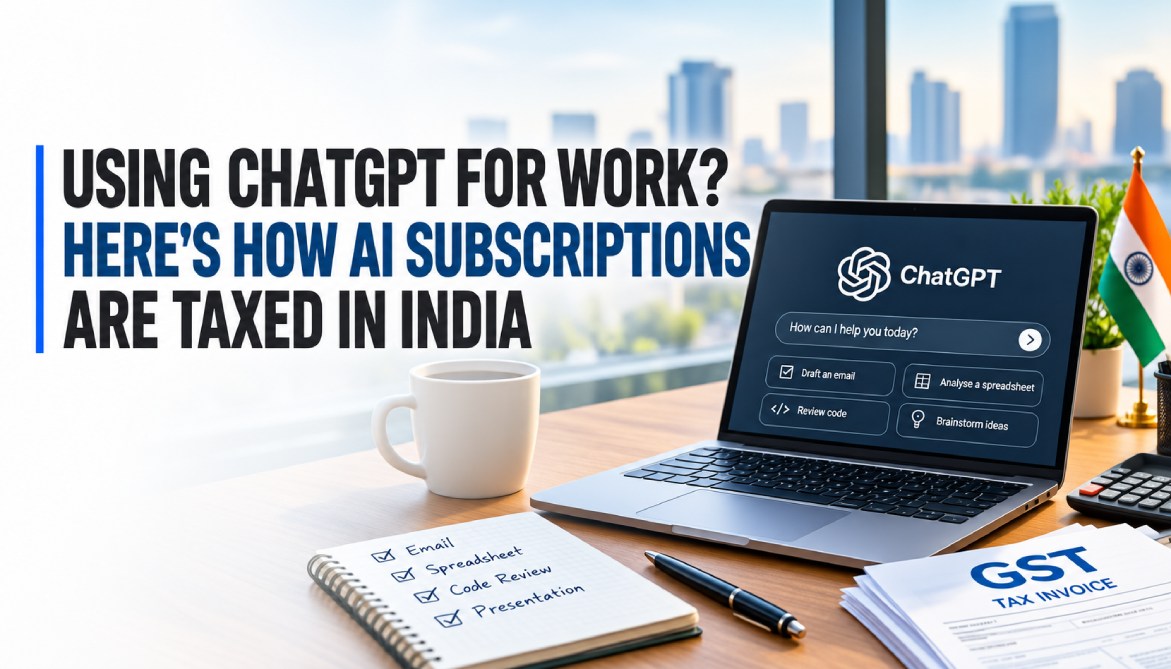
You ask ChatGPT to draft an email, analyse a spreadsheet, review code or brainstorm a presentation.
You pay for a subscription.
The invoice comes from an overseas technology company.
And that is where the tax story begins.
As AI tools such as ChatGPT become part of everyday business operations, Indian companies, professionals and even individual users are increasingly paying foreign service providers for subscriptions, enterprise access and APIs. What often looks like a simple monthly software expense can actually raise questions under GST, Reverse Charge Mechanism, OIDAR rules and Income-tax withholding provisions.
So, if your business pays for ChatGPT or another overseas AI platform, who pays GST? Can the business claim Input Tax Credit? Is TDS required? And does it make a difference whether you are using the tool personally or commercially?
It does.
First, How Does GST See a ChatGPT Subscription?
For tax purposes, ChatGPT is not looked at merely as an “AI tool”.
The more relevant question is how the service is delivered.
Standard AI platforms are accessed online, operate through digital infrastructure, generate outputs automatically and involve little or no human intervention in delivering each individual response.
These characteristics bring such services within the broad framework of Online Information and Database Access or Retrieval services — commonly known as OIDAR services under the IGST Act.
This category is important because India has specific GST rules for digital services supplied from outside India to customers located in India.
And the tax treatment changes significantly depending on who is using the AI service.
Using ChatGPT Personally? GST Is Usually Built Into the Transaction
Suppose an individual in India purchases an AI subscription for personal use and is not registered under GST.
In such a case, the overseas digital service provider generally has the responsibility to collect and discharge IGST under the mechanism applicable to OIDAR services supplied to an unregistered customer in India.
For the user, this is relatively straightforward.
You purchase the subscription, tax is charged as applicable, and there is no Input Tax Credit because the service is being consumed personally.
But the position changes when the same subscription is bought by a GST-registered business.
Using ChatGPT for Business? Reverse Charge Comes Into the Picture
Suppose an Indian company, LLP, CA firm, software developer or another GST-registered business purchases an AI subscription from an overseas vendor.
The foreign vendor may issue an invoice without charging Indian GST.
That does not necessarily mean there is no GST liability.
The Indian business may instead be required to pay IGST itself under the Reverse Charge Mechanism (RCM) as an import of service. The source article discusses the applicable GST rate as 18%.
Consider a simple example.
If an Indian company spends ₹10 lakh annually on AI subscriptions or API access, an 18% RCM liability would amount to ₹1.8 lakh.
The company would pay that GST through the prescribed mechanism and, if the service is used for business and all ITC conditions are satisfied, may generally claim the corresponding Input Tax Credit.
This is where the economics become interesting.
For an eligible business, the GST paid under RCM may be largely tax-neutral because the same amount can potentially come back as ITC.
For a personal user, there is no such credit.
Same AI tool. Very different tax outcome.
What About ChatGPT API and Enterprise Plans?
The tax issue is not limited to a simple ChatGPT subscription.
Many Indian technology companies are now integrating foreign AI APIs into their own software, customer-service platforms, automation tools and internal applications.
Others are purchasing enterprise workspaces for dozens or hundreds of employees.
From a GST perspective, the underlying logic remains similar: where a GST-registered Indian entity procures electronically supplied AI services from an overseas provider, the transaction may constitute an import of service and attract GST under RCM, subject to the precise facts and contractual arrangement.
Businesses therefore need to look beyond the corporate card transaction.
The accounting and tax teams should know:
- who the contracting entity is;
- where the vendor is located;
- whether GST has already been charged;
- whether RCM applies; and
- whether eligible ITC has actually been claimed.
Otherwise, an innocent-looking SaaS or AI subscription can become a recurring compliance gap.
Then Comes the Bigger Question: Is TDS Required?
GST is only one part of the story.
A payment from an Indian business to a foreign AI service provider can also raise questions under the Income-tax Act and the relevant Double Taxation Avoidance Agreement (DTAA).
The central issue is whether the payment can be characterised as Royalty or Fees for Technical Services / Fees for Included Services.
The distinction matters because such characterisation can affect withholding obligations under Section 195.
The source article takes the view that ordinary access to an AI platform — without transfer of source code, copyright or proprietary technology — may generally be distinguished from a royalty payment.
In practical terms, paying to use ChatGPT is not the same thing as acquiring ownership or rights over the technology behind ChatGPT.
You are buying access.
You are not buying the model.
That difference is important.
Is an AI Response a “Technical Service”?
This is where the discussion becomes even more interesting.
Traditional technical-service taxation often involves some element of specialised human intervention or expertise.
But with generative AI, the response is produced automatically by software.
There may be no engineer, consultant or subject-matter expert personally delivering the response at the other end.
The source article therefore considers that fully automated AI services may, depending on the applicable DTAA and facts, not automatically fit the traditional characterisation of Fees for Technical Services or Fees for Included Services.
It further suggests that where the payment is not taxable as Royalty or FTS/FIS and the foreign provider does not have a Permanent Establishment in India, Section 195 withholding may not necessarily arise.
But this is one area where businesses should resist applying a blanket rule.
The exact contract, service package, jurisdiction of the provider and applicable DTAA still matter.
The Tax Treatment Can Change With the User
This is perhaps the most useful way to understand taxation of AI services.
A ChatGPT subscription purchased by an individual for personal use is one transaction.
The same subscription purchased by a CA firm for professional research is another.
Enterprise AI access purchased by a large corporation is another.
And API access embedded into a SaaS platform is yet another.
The technology may be identical.
The tax treatment need not be.
That is because GST and Income-tax rules look not only at what was purchased, but also at who purchased it, from whom, how it is delivered and what rights or services the contract actually provides.
What Should Indian Businesses Do?
For most businesses, the compliance is not complicated if the process is set up correctly.
The bigger risk is simply forgetting that these subscriptions are cross-border procurements.
Businesses using ChatGPT, AI APIs or similar overseas digital platforms should maintain proper vendor invoices, ensure the correct legal entity and GSTIN are reflected where relevant, evaluate RCM liability, claim eligible ITC and review whether any foreign-remittance or withholding-tax compliance is required.
As AI spending grows, what was once a ₹2,000 monthly software subscription can quickly become a much larger enterprise technology cost.
At that point, treating it as “just another credit-card expense” is no longer enough.
The Bigger Takeaway
AI may feel borderless.
Tax law is not.
A prompt may travel to a foreign server and return an answer in seconds, but the payment behind that interaction can still trigger very traditional questions around GST, imports of services, reverse charge, ITC, royalty and withholding tax.
So the next time someone in your organisation says:
“We just bought a ChatGPT subscription.”
The finance team may want to ask one more question:
“Personal account, business subscription or API?”
Because from a tax perspective, that detail could change everything.
What You Need To Keep In Mind
Overseas AI subscriptions such as ChatGPT may fall within the OIDAR / digitally supplied services framework under GST.
For unregistered personal users, GST may generally be collected by the overseas provider under the applicable mechanism.
GST-registered Indian businesses may need to pay IGST under RCM on overseas AI services and can potentially claim eligible ITC.
Standard AI access does not automatically mean a royalty payment for Income-tax purposes; the rights granted under the contract matter.
TDS under Section 195 should be evaluated based on the nature of the payment, the relevant DTAA and the foreign service provider’s tax position.
As enterprise adoption of AI grows, businesses should bring AI subscriptions and API payments into their regular GST and foreign-remittance compliance processes.