
Supreme Court Grants Tax Relief to Rooh Afza: A Landmark Ruling on Beverage Classification
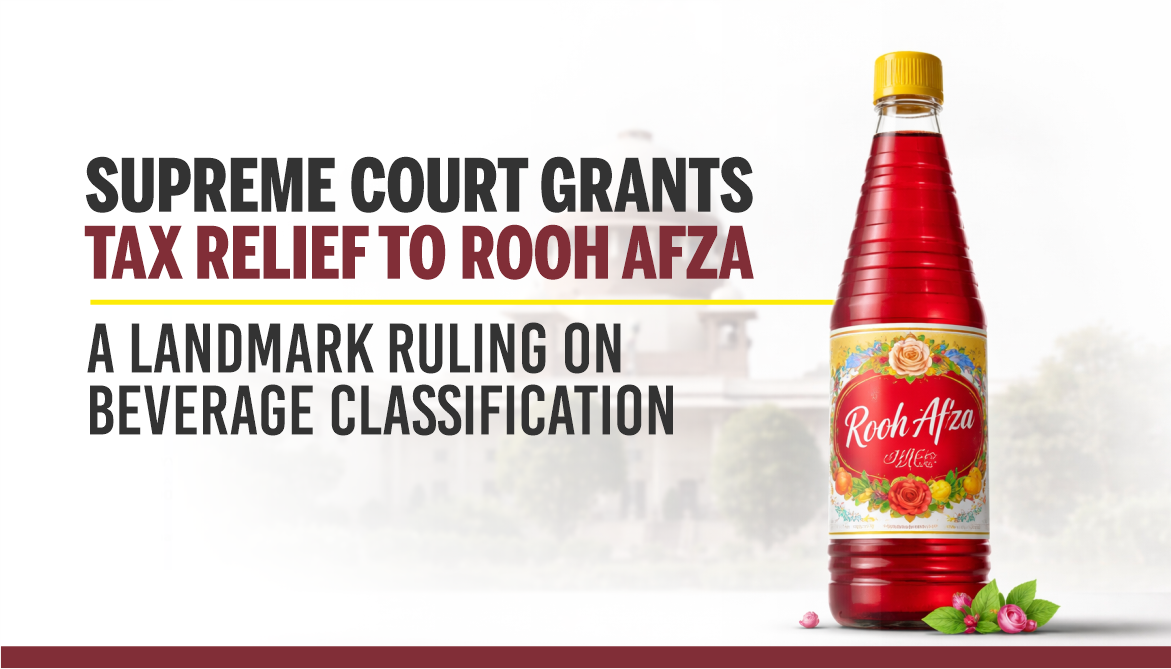
In a significant relief to beverage manufacturer Hamdard Laboratories, the Supreme Court has held that Rooh Afza is to be classified as a “fruit drink” and not as a higher-taxed syrup or concentrate. The ruling brings clarity to a long-running classification dispute and may have wider implications for the beverage industry under India’s indirect tax framework.
The Background: A Dispute Over Classification
Rooh Afza, a century-old summer staple in Indian households, has traditionally been marketed as a sharbat or fruit-based drink concentrate. The tax controversy arose from how the product should be classified under indirect tax laws — first under the pre-GST regime (VAT/excise), and subsequently under GST principles.
Tax authorities had taken the view that Rooh Afza should be treated as a “syrup” or “concentrate” falling under a higher tax bracket. Their argument rested on the product’s concentrated nature and the fact that it is typically diluted before consumption. A higher classification would naturally lead to a greater tax burden.
Hamdard, on the other hand, argued that Rooh Afza is fundamentally a fruit drink preparation, made from fruit extracts and other ingredients, and should therefore attract a lower rate applicable to fruit-based beverages. The dispute ultimately travelled through appellate forums before reaching the Supreme Court.
The Core Legal Issue
At the heart of the case was a familiar yet complex question in indirect taxation: How should a product be classified when it straddles multiple descriptive entries?
Under tax law, classification determines the applicable rate. The process is not merely semantic; it relies on statutory interpretation, tariff headings, explanatory notes, product composition, manufacturing process, and the common parlance test.
The revenue authorities leaned on the argument that the product’s form — a thick, sweetened liquid requiring dilution – resembled a syrup or concentrate. They likely relied on tariff interpretations that classify concentrated preparations separately from ready-to-drink beverages.
Hamdard’s defence focused on product identity and consumer perception. Rooh Afza is not sold as a generic sugar syrup; it is marketed and consumed as a fruit-based summer drink. Its ingredients include fruit extracts and flavouring agents traditionally associated with fruit beverages. The company argued that classification must consider how the product is understood in the market — not merely its viscosity or dilution requirement.
The Supreme Court’s Reasoning
The Supreme Court sided with Hamdard Laboratories, holding that Rooh Afza merits classification as a fruit drink. While the detailed reasoning spans statutory interpretation, the broader principles are clear:
-
Common Parlance Test Prevails: Courts often rely on how a product is perceived in the market. If consumers and traders treat it as a fruit drink, that understanding carries significant weight.
-
Substance Over Form: The mere fact that a beverage requires dilution does not automatically convert it into a syrup for tax purposes.
-
Consistency in Interpretation: Classification must align with the product’s essential character and composition rather than isolated physical attributes.
The ruling reinforces the principle that tax classification cannot be reduced to mechanical categorisation. Instead, it requires a holistic view of the product’s identity.
VAT Regime Dispute
It is important to note that the dispute arose under the pre-GST VAT regime, where classification directly determined the applicable tax rate. Fruit drinks were generally taxed at a lower rate (around 12.5% or 5% in certain periods), whereas syrups and concentrates attracted a significantly higher rate (often 20% or more). The rate differential made the classification commercially critical.
The Supreme Court examined the product’s composition and market identity, applying the common parlance and substance-over-form principles. It held that mere dilution before consumption does not alter the essential character of the product. Since Rooh Afza is understood in trade and by consumers as a fruit-based drink, it was rightly classifiable as a fruit drink under the VAT schedule.
Why This Matters Beyond Rooh Afza
Although the dispute relates specifically to Rooh Afza, the implications extend well beyond one brand.
1. Guidance on Beverage Classification
The beverage industry operates in a nuanced space. Products range from ready-to-drink juices and carbonated drinks to concentrates, squashes, syrups, and health beverages. Tax rates often vary across these categories. This ruling provides judicial clarity that products requiring dilution may still qualify as fruit drinks if their essential character and market identity support such classification.
2. Reduced Litigation Risk for Similar Products
Many manufacturers produce fruit-based concentrates, herbal beverages, and traditional drink preparations. This judgment may serve as persuasive precedent in ongoing or future disputes involving similar products. Businesses facing classification challenges can rely on this decision to argue for a substance-based approach rather than a narrow textual interpretation.
3. Reinforcement of the Common Parlance Doctrine
Indian indirect tax jurisprudence has long recognised the “common parlance test.” The Supreme Court’s reaffirmation strengthens the position that consumer perception and trade understanding are central to classification disputes. This is particularly relevant under GST, where rate differentials remain significant across product categories.
4. Financial and Compliance Impact
For Hamdard, the ruling likely translates into substantial tax savings and possibly refund claims, depending on the procedural posture of the case. For the industry at large, it underscores the importance of carefully evaluating product descriptions, labels, ingredients, and marketing positioning in light of tariff entries. Businesses may now re-examine their product portfolios to ensure alignment between classification adopted and judicial principles.
Conclusion
The Rooh Afza ruling is more than a tax technicality. It is a reaffirmation of foundational principles in indirect tax law – that product identity, market perception, and essential character matter more than rigid form-based distinctions.
For the beverage industry, the decision offers clarity and potential relief. For tax professionals, it serves as a useful precedent in classification analysis. And for policymakers, it underscores the continuing need for precise drafting and harmonised interpretation within India’s evolving GST framework.
As summer approaches and glasses of Rooh Afza return to dining tables, the iconic drink now carries not just a refreshing legacy – but also a judicial stamp defining its place in the tax statute.