
SC: No GST on Residential Premises Used as Student Hostels
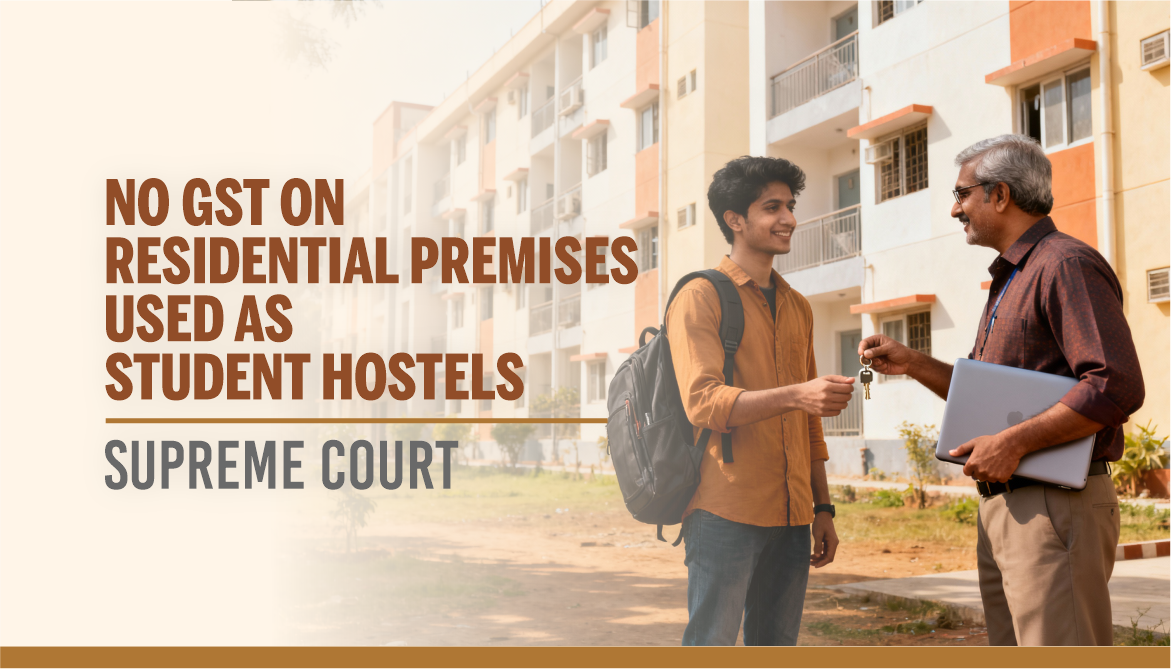
In a significant ruling that clears long-standing ambiguity in the GST regime, the Supreme Court has held that leasing of residential premises to an entity for use as a hostel for students and professionals is exempt from GST.
This verdict upholds the Karnataka High Court’s earlier decision and sets a precedent likely to bring relief to landlords and service providers across the country. The decision reaffirms the interpretation that the end-use of a property for residential purposes – regardless of the commercial nature of the lessee – should remain the focal point when determining GST applicability.
Background: A Long Journey Through the Courts
The dispute originated when a co-owner of a 42-room residential property in Bengaluru entered into a lease agreement with a company operating long-term hostels for students and professionals. The lease tenure spanned three to twelve months, clearly indicating residential-style accommodation.
Seeking certainty on the GST implications of such a transaction, the owner approached the Karnataka Authority for Advance Rulings (AAR). The AAR denied the exemption, ruling that the property was being used as a hostel and did not fall within the ambit of “residential dwelling” under Entry 13 of Notification No. 9/2017–IGST (Rate) dated 28.06.2017.
The Appellate Authority for Advance Ruling (AAAR) reaffirmed this view, treating the use as commercial in nature, thereby attracting 18% GST.
Aggrieved, the petitioner moved the Karnataka High Court, which took a divergent view. The High Court held that, since the ultimate purpose was residential accommodation – even if carried out by a corporate entity – the exemption should apply. The Supreme Court has now upheld the High Court’s reasoning.
Understanding the Legal Context: What Is a ‘Residential Dwelling’?
Under Entry 13 of Notification No. 9/2017–IGST (Rate), services by way of renting of residential dwelling for use as residence are exempt from GST. The term “residential dwelling” is not explicitly defined in the GST law, leading to differing interpretations.
The tax authorities have often argued that if the lessee is a business entity, the transaction should be treated as a commercial lease. On the other hand, several High Courts have taken a more purposive view, holding that the exemption applies as long as the ultimate use remains residential.
This judgment from the Apex Court reinforces the latter interpretation: the nature of the end-use – i.e., residential accommodation – is decisive, not the legal status or business activity of the lessee.
Persistent Ambiguity in Residential vs Commercial Use
Since the introduction of GST, confusion has persisted over the classification of properties based on their use, particularly when leased to companies. Some key areas of ambiguity have included:
-
Employee Housing: Whether a company leasing flats for its employees qualifies for exemption.
-
Student Hostels: Are hostels operated by private entities considered residential?
-
Service Apartments: Whether serviced accommodations, often with hotel-like amenities, qualify as residential use.
Multiple Advance Rulings have swung both ways, depending on the facts and the state jurisdiction. Inconsistent interpretations created compliance challenges and potential litigation for property owners and tenant businesses alike.
Supreme Court’s Reasoning: Legislative Intent Prevails
The Supreme Court noted that the legislative intent behind the GST exemption was to make housing affordable. Imposing an 18% GST in such arrangements would defeat this intent, as the tax burden would ultimately be passed on to end-users – students and working professionals.
Quoting the judgment:
“The ultimate use of the property as residence remains unchanged. If 18% GST is levied, the same would ultimately be passed on to the students and working professionals, defeating the exemption’s legislative purpose.”
This reasoning aligns with earlier judicial interpretations, including the Delhi High Court ruling in Taghar Vasudev Ambrish v. Appellate Authority for Advance Ruling, which similarly held that the exemption cannot be denied merely because the lessee is a commercial entity.
Implications for Taxpayers and Industry
1. Relief for Hostel Operators and Property Owners
Entities running long-stay hostels for students and professionals now have a more precise tax position. Leasing residential premises for such use will not attract GST, provided the end use is residential.
2. Clarification for Corporate Leases
Companies leasing residential units for employee accommodation can rely on this precedent to argue for exemption, though documentation of the actual use will remain critical.
3. Potential for Refund Claims
Taxpayers who have wrongly charged or paid GST on similar transactions may consider exploring refund avenues, subject to limitation periods under Section 54 of the CGST Act.
4. Impact on Ongoing Litigations
This ruling will have persuasive value across forums and is likely to be relied upon in disputes pending before AARs, appellate tribunals, or High Courts.
Conclusion: A Welcome Clarification in the GST Landscape
The Supreme Court’s verdict in the Taghar Vasudeva Ambrish & ANR case is not merely a resolution of one dispute – it is a definitive clarification in a grey area of GST law. By focusing on the substance of the transaction rather than the form, the Court has upheld the principle of purposive interpretation in taxation.
While clarity has been provided for one type of transaction, broader issues in property classification under GST still require legislative or administrative resolution. Until then, this judgment will serve as a critical reference point for taxpayers navigating the complex residential-commercial divide.