
GST on Coaching Services: CFI Seeks Rate Cut to 5% or Nil
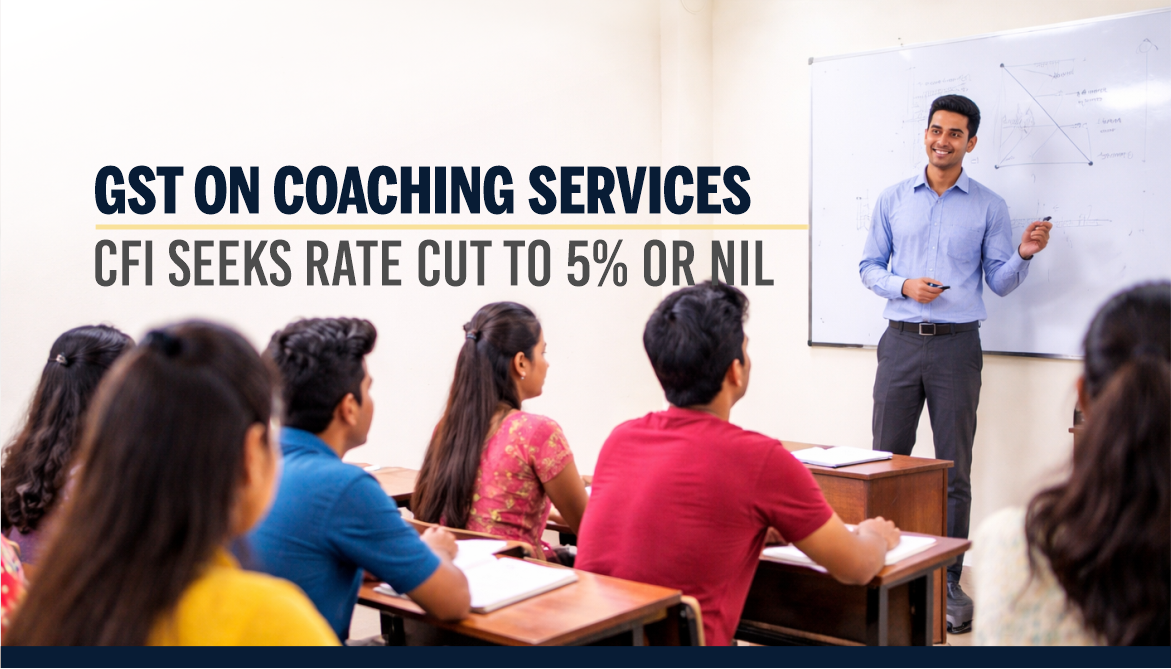
In a significant representation ahead of the Union Budget 2026, the Coaching Federation of India (CFI) has called on Finance Minister Nirmala Sitharaman to rationalise the Goods and Services Tax (GST) on coaching and supplementary education services by reducing the rate to 5% or zero. The Federation’s proposal, submitted on 28 January 2026, argues that the current tax structure directly increases coaching fees borne by families and adversely affects small and medium-sized coaching businesses across the country.
In its submission, the CFI emphasised that unlike manufacturing or trading firms that can significantly utilise input tax credit (ITC), coaching institutes have limited scope to offset tax. As a result, the GST becomes a direct add-on to student fees, effectively shifting the entire tax burden onto parents. The Federation also challenged the current GST exemption threshold of ₹20 lakh, describing it as outdated in an era of rising rents, salaries, and operating costs, and proposed increasing it to ₹1 crore to protect smaller institutes.
Why This Matters: Context of Coaching and GST in India
GST, introduced in India in July 2017, is a comprehensive indirect tax replacing a host of central and state levies. It is levied on goods and services at multiple rate slabs, generally ranging from 0% and 5% (essential) to 18% (standard) and 40% (luxury/sin goods), following the GST reform in September 2025 which streamlined multiple rates into fewer slabs.
However, services supplied by coaching centres and supplementary education providers continue to attract GST — typically at the standard rate of 18% — unless specifically exempted. This classification has been a longstanding contention for the sector, largely because these services are not treated as “educational institutions” under current GST rules and thus do not fall within exemptions similar to formal school/college tuition fees.
For millions of Indian students and families, coaching institutions — spanning preparation for competitive examinations such as JEE, NEET, CUET, CA, CLAT, SSC, and UPSC — have become virtually indispensable. What was once considered an optional “supplement” has evolved into a near-universal component of academic strategy for aspirants seeking admission into professional courses or securing government jobs.
Thus, the CFI’s appeal frames the GST issue not merely as an industry concern but as a wider socioeconomic affordability issue, arguing that taxing coaching services adds to the cost of education and places disproportionate pressure on middle-class families already coping with rising household expenditures.
Taxation Aspect: GST Structure and Coaching Services
1. GST and Input Tax Credit in Service Sector
Under the GST regime, registered businesses can claim input tax credit for GST paid on inputs and services used in supplying taxable services. This system is designed to avoid the cascading effect of taxes and reduce the overall tax burden. However, coaching and supplementary education service providers typically incur major costs in salaries, academic material, and space rental — categories where the ability to claim meaningful ITC is limited.
Consequently, rather than being able to neutralise the tax through ITC, the GST often becomes a cost addition for these providers. Many pass this cost directly to students through higher coaching fees, intensifying concerns around educational affordability.
2. Exemption Thresholds and Small Businesses
The current GST law provides an exemption threshold for service providers whose annual turnover does not exceed ₹20 lakh in most states (₹10 lakh in some North-Eastern states). Above this threshold, registration and compliance obligations under GST become mandatory.
The CFI argues that this ₹20 lakh limit was set in a significantly different economic context and no longer reflects the realities of rising operating expenses. Smaller institutes, even with modest margins, often cross this threshold and face tax and compliance burdens that larger players can more efficiently manage. A revised threshold of ₹1 crore would effectively exclude many MSME-scale coaching providers from mandatory registration, easing compliance burdens and encouraging formalisation.
3. Sector Distortion and Informality
A critical point raised by the Federation is that the current GST structure may inadvertently distort the sector by encouraging informal practices. Small centres might choose to stay unregistered to avoid tax and compliance, whereas parents sometimes prefer “no-GST” options to economise. This, the CFI suggests, hampers voluntary compliance and undermines transparent business practices in the sector.
Potential Implications and Stakeholder Expectations
If the Finance Minister and GST Council, in their upcoming deliberations around the Budget 2026 (to be presented on 1 February 2026), take up the CFI’s recommendations, there could be several far-reaching implications:
-
Cost Relief for Families: A reduction or exemption could reduce the out-of-pocket expenditure of students and parents, potentially widening access to supplementary education.
-
Boost to Small & Mid-Size Coaching Businesses: Higher exemption thresholds and lower tax rates can alleviate compliance costs and help protect MSME coaching centres financially.
-
Formalisation and Compliance: A balanced tax regime might reduce the lure of informal markets and strengthen the formal GST net.
However, any move to alter GST rates or thresholds will need careful calibration to preserve revenue buoyancy for the exchequer while balancing educational and equity considerations.
Conclusion
The CFI’s appeal to the Finance Minister underscores a broader policy challenge in India’s indirect tax framework: aligning taxation with evolving socioeconomic needs. Coaching has transformed from a discretionary add-on to a de facto necessity for student success in competitive examinations. As such, the current GST framework’s rigidity may inadvertently burden families and constrain smaller education enterprises.
The upcoming Budget 2026 provides an opportunity for policymakers to revisit coaching services’ GST treatment, balancing revenue imperatives with social objectives such as affordability, access, and equitable growth in the education ecosystem. Ultimately, any rationalisation of GST in this sector will not only impact the coaching industry but could influence broader debates on how the tax system accommodates essential support services in a rapidly changing economic landscape.